






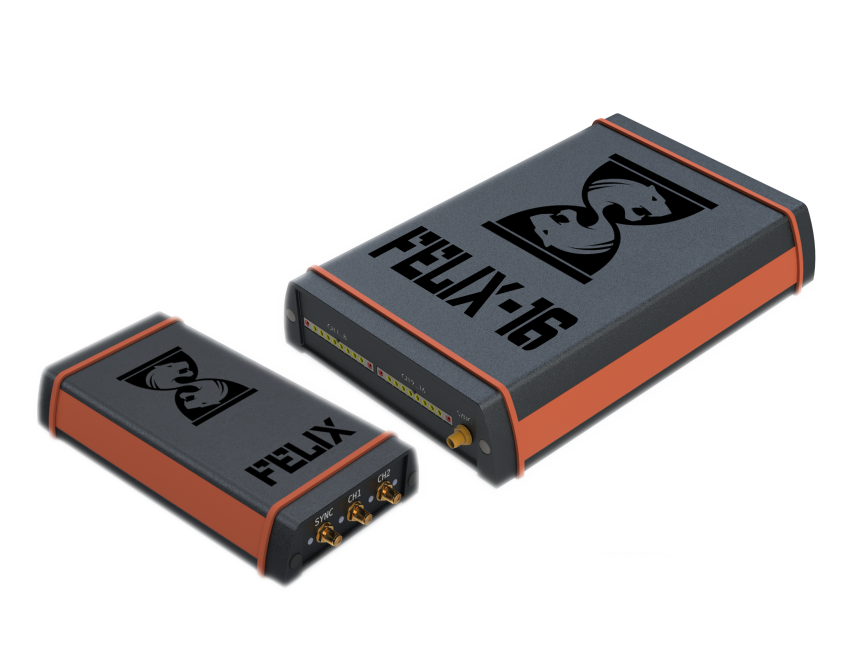

We design and manufacture high-performance time taggers for research and industry applications
Our ProductsSystem Integration
SCROLL ↓
WHAT WE DO

We start from ideas and turn them into requirements first, before deploying reliable solutions.
From concept to design: we create schematics, layout and prototype PCBs for the desired functionalities.

We develop complex and high- performance FPGA Firmware for our and your devices

We enable device use via user-friendly interfaces, flexible APIs and integration tools
APPLICATIONS
Fluorescence lifetime methods analyze the molecular environment (pH, oxygen, FRET) by measuring the excited state duration, independent of concentration or intensity. This is applied in FLIM (lifetime maps) and FCS (diffusion and binding kinetics). Precision is limited by the Instrument Response Function (IRF)—composed of laser pulse, jitter, and
TDC resolution—with sub-100 ps being the standard. High count rates and low dead times are essential for rapid imaging and accurate decay profiles.
Conventional PET identifies a line of response between two coincidence photons, while ToF-PET specifies the annihilation point—a timing principle shared by medical CT and synchrotrons. The Coincidence Time Resolution (CTR) governs position uncertainty; reducing it from ~500 ps (PMTs) to low-200 ps (SiPMs) roughly doubles sensitivity. Further improvements to 100 ps significantly boost SNR, with current R&D pushing toward a 10 ps “challenge” regime.
TCSPC LiDAR determines depth by histogramming photon arrival times, remaining effective in low-light or scattering conditions; ToF tomography extends this to internal imaging.
Range resolution is proportional to timing jitter (Δ z = c · σ/2), where 100 ps corresponds to ~1.5 cm. Time-tagged acquisition further enhances background rejection and dynamic range.
Single-photon sources are characterized by g²(τ) using a Hanbury Brown–Twiss setup, where g²(0) < 0.5 identifies a true emitter. This timing-based approach also enables HOM
interference (indistinguishability) and time-bin QKD/QRNG. The correlation peak width is determined by detector jitter, skew, and TDC resolution rather than the emitter; thus, jitter reduces measured single-photon purity. Precise skew calibration is vital for HOM, while QKD/QRNG require long-term stability and high MHz throughput.
Time-resolved photoluminescence (TRPL) is the semiconductor standard for analyzing carrier lifetimes, recombination, and defects in devices like LEDs and solar cells, and for characterizing scintillators and photon detectors. To separate decay components ranging from sub-ns (trap-assisted) to μs (radiative), a resolution below 10 ps, a wide timing window, and multi-channel capability are required.
Neutron and gamma events are classified using Pulse Shape Discrimination (PSD), which analyzes decay shapes, or Time of Flight (n-ToF), based on flight time; both are used in nuclear physics and security. PSD requires 100–500 ps timing for reliable pulse separation, while n-ToF needs 50–200 ps resolution, wide timing windows, and low drift to ensure stable classification.
Time-resolved mass spectrometry, photovoltaics, and optical communication testing respectively analyze ion flight, carrier dynamics, and link jitter. All three require sub-ns resolution, long timing windows, and stable synchronization, making the time tagger the primary measurement instrument rather than just a component.
Beam diagnostics analyze electron bunch structures (few ps) and synchronization between beam, RF, and laser systems (e.g., for FELs), while HEP uses time-of-flight for particle
identification and event reconstruction. These applications require 1–10 ps jitter and low drift, with sub-ps synchronization (e.g., White-Rabbit). In HEP, achieving 10–50 ps resolution across thousands of channels with deterministic latency is essential for particle ID.
FEATURED PRODUCTS
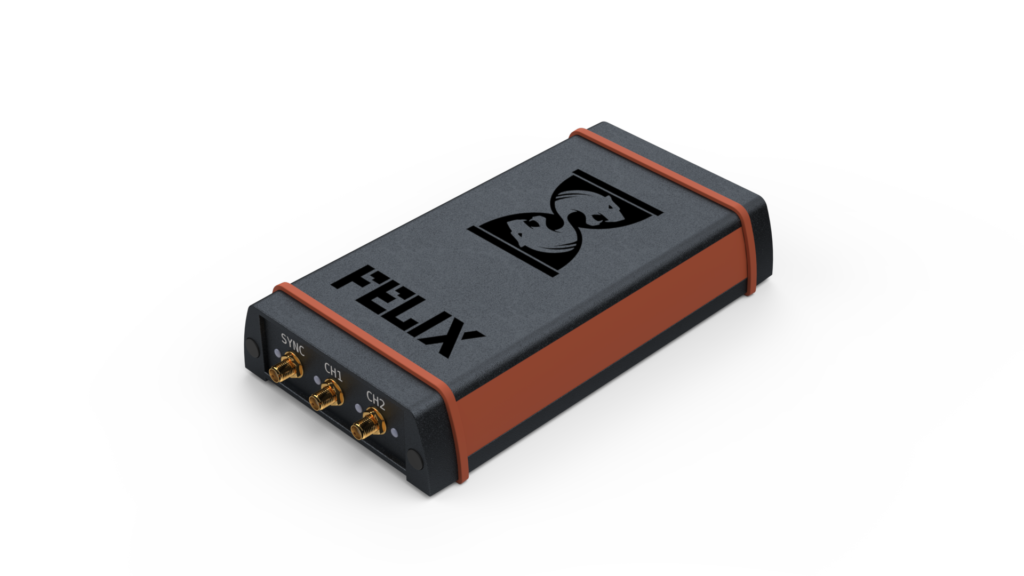
A simple, small but high-performance Time Tagging platform, base of our product lines, designed for research and industry applications
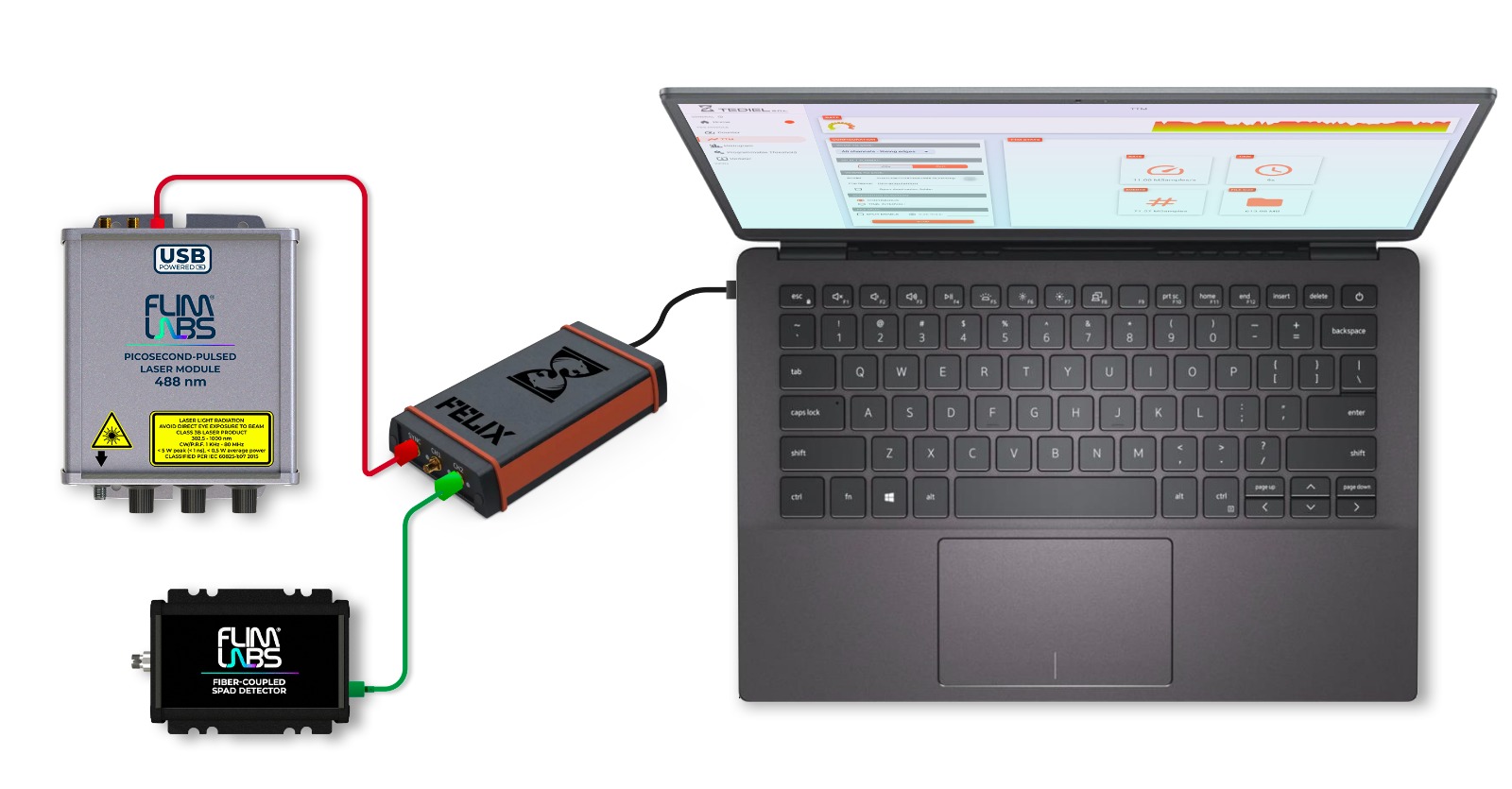
A complete acquisition stack for quantum optics and FLIM experiments — hardware and software ready out of the box.
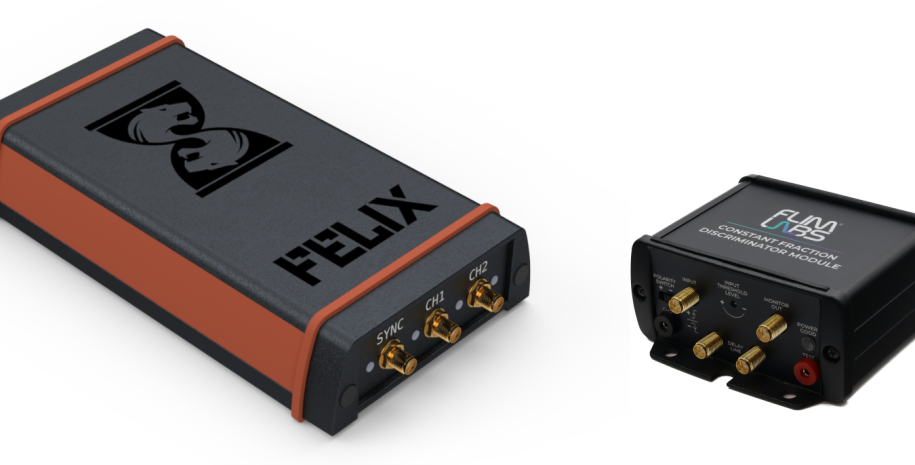
A useful combination of Felix Time Tagger and FLIM LABS CFD to either work with negative signals on Felix, or compensate time-walk error